
The Blind Spot of the Robot Frenzy - Why a Smarter Arm Won’t Change the Physical World
 リギリ 聡美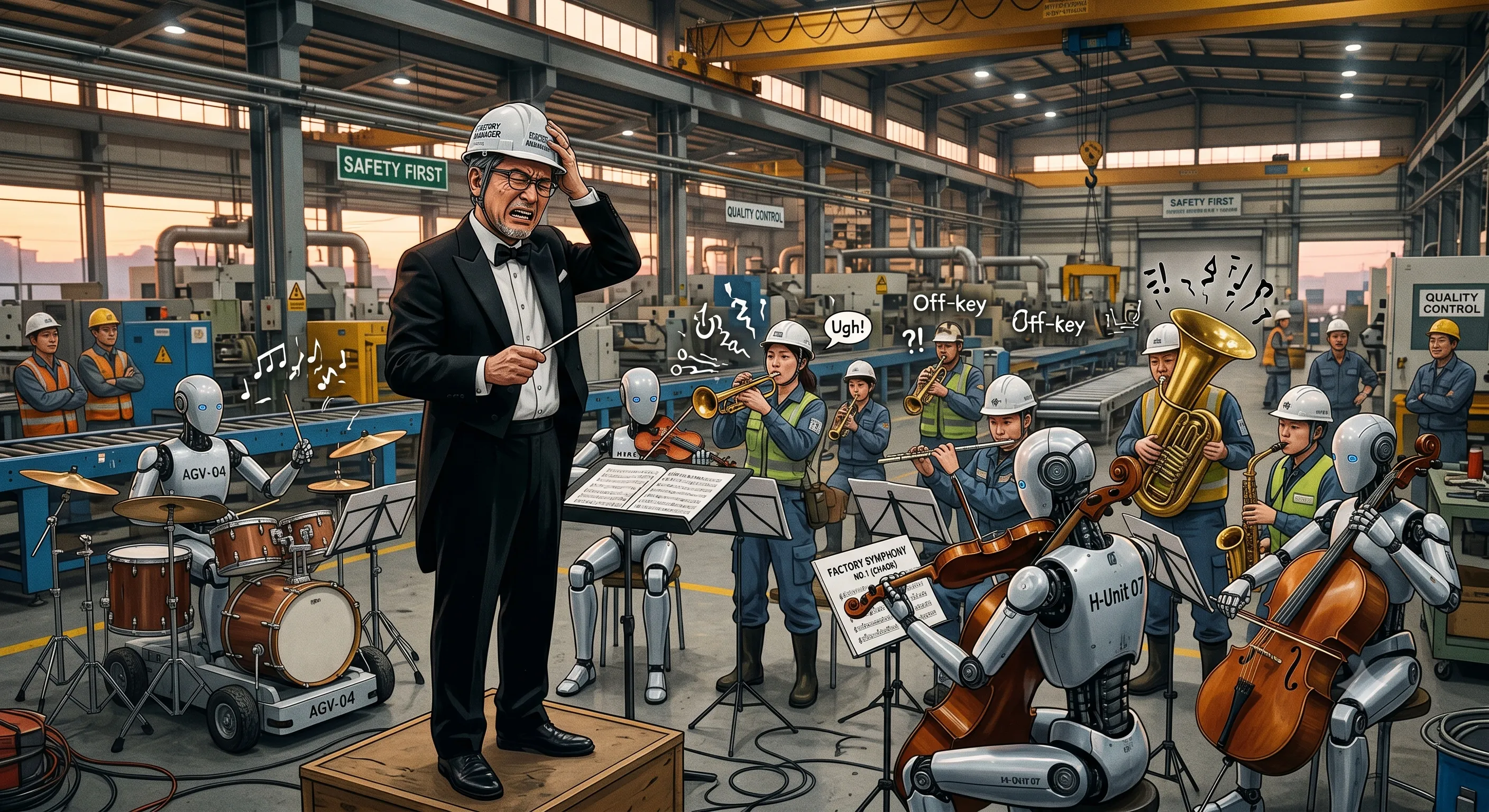
“Figure AI’s humanoids have been deployed to BMW’s factories to support vehicle production.” “Jeff Bezos, NVIDIA, and others are firing off one mega-investment after another—on the order of hundreds of billions of yen—into startups building the ‘brains’ of robots.” The wave of physical AI crashing in from overseas is no longer a story about the United States alone.
In neighboring China, the government (the Ministry of Industry and Information Technology, among others) announced in June 2026 a large-scale action plan to deploy 10,000 humanoid robots to commercial sites by the end of 2026 and to drive the collection of real-world data on a national scale. In Japan, too, it made headlines when Japan Airlines (JAL) began trialing robots made by China’s Unitree to automate airport operations. As if in response, Rhoto Pharmaceutical has launched a project to introduce humanoid robots onto its manufacturing floor, and the government has begun positioning ‘physical AI’ as a strategic national bet. Media and investors are now being swept along by global headlines, eyes fixed on flashy robot videos.
And yet, the more familiar you are with the shop floor, the more uneasy this boom should make you feel. When, exactly, did the definition of physical AI narrow to “bipedal robots” and “robot arms”? Things that move are not the only form of physical AI. Elon Musk once described the essence of manufacturing as “the machine that builds the machine.” True physical AI is not about merely making a robot arm more sophisticated. It refers to a state in which an entire factory or facility behaves as a single, vast intelligence that optimizes the production line on its own, learns, and keeps evolving. The real protagonist is not the robot, but the space itself—the entity that holistically understands processes, flow lines, equipment layout, and operational data.
The age of showing off a single device is over. Physical space itself becomes intelligent, and everything in it works together toward one goal. This is the true definition of the physical AI we are tackling. This article unpacks the blind spots of today’s fragmented physical-AI boom—and our essential path to winning by hacking space itself—grounded in objective data.
1. The “Local-Optimization Trap” That Paralyzes the Floor
Much of today’s physical-AI development is preoccupied with functions like how quickly a particular robot arm can grasp a part. Real factories and warehouses, however, are far more dynamic and complex.
In logistics and manufacturing, for example, roughly 5.8 million forklifts are in operation worldwide.¹ Moreover, according to research by the logistics-research firm LogisticsIQ,² annual shipments of AGVs (automated guided vehicles) and AMRs (autonomous mobile robots) are projected to reach 700,000 units per year by 2030, with a cumulative installed base of 3 million units. That many “moving machines” share the same space as human workers, who move in unpredictable ways.
No matter how much you shave off an arm’s cycle time—even a single second—if the AGV bringing the materials stalls along the way, or if a robot repeatedly makes emergency stops because it collides with a worker’s path, the productivity of the floor as a whole actually declines.
However clever you make the robot—the “point”—it means nothing unless the space—the “plane”—is in harmony as a whole. When space acquires intelligence, a logistics warehouse ceases to be a mere collection of “robots that move packages” and is transformed into a single, enormous machine in which the whole space “completes the logistics autonomously.”
2. The Rise of Simulation—and the “Final 10%” It Still Can’t Cross
The other blind spot is the “quality and quantity of data” required to make physical AI genuinely practical.
Today, Japan’s factories and logistics sites face the worst labor shortage in their history. The biggest risk is losing the hands-on know-how of skilled workers, which has never been turned into data but has kept these sites running for decades.
Of course, many sites are not standing by idly in the face of this crisis. Recently, “video-analysis tools”—which film the physical movements and work processes of experts and novices on camera and use AI to compare and analyze the differences—are being trialed. But there is a fatal limitation here: “enormous effort and time (cost).”
Installing cameras everywhere to eliminate blind spots, having humans check vast volumes of video and label it for AI (annotation), and then analyzing it—this labor-intensive approach may be fine for spot-analyzing the work in one narrow booth. But continuously running it 24/7/365 across a vast factory or warehouse, and continuously collecting data at a scale sufficient to train an AI model, is structurally impossible.
Big Tech companies worldwide are rapidly accelerating robot learning using sophisticated simulated environments (synthetic data). Indeed, special training in virtual space has improved machines’ basic physical capabilities. But what practitioners on the floor confront is a brutal reality: “Even if simulation can cover 90% of the basic motions, the ‘final 10%’ needed to operate 100% safely on the real floor simply will not close.”
Synthetic data can cleanly “approximate” the laws of physics, but it cannot reproduce the “living behavior” that occurs on a real floor: the faint flicker of aging lighting, uneven smears of oil on the floor, the minute drift of a sensor caused by dust, and the “raw trajectory data” of a veteran adapting flexibly to conditions on the ground.
However elite an education an AI receives in virtual space, the moment it faces this gritty reality it becomes useless. That is the true difficulty of physical AI.
This is precisely why, on industrial floors where 100% certainty is demanded, you need an advanced edge architecture that—without troubling human hands at all—continuously and automatically captures “the movement of the entire floor” at 1–2 meter accuracy across the whole of long-running operational processes, while fully suppressing accumulated error (drift). And then the “real, living data of the floor” that can be drawn up only from that infrastructure—data that simulation can never create. Only when these two are in place does AI truly function in the physical world.
3. zeteoh’s Mission: A Staircase to the “World Model,” Starting by Hacking Location Data
We at zeteoh are not a company that builds the “bodies” of robots. Our aim is to build a “shared brain”—an industrial world model—in which every physical space autonomously “perceives, reasons, and acts,” contributing to the flourishing of humanity.
As the breakthrough toward this, we began our approach by acquiring dynamic-state data, including location data, through spatial AI.
Why dynamic-state data? Because it is the “minimum unit (the infrastructure layer)” for computing the optimization and autonomy of the entire space.
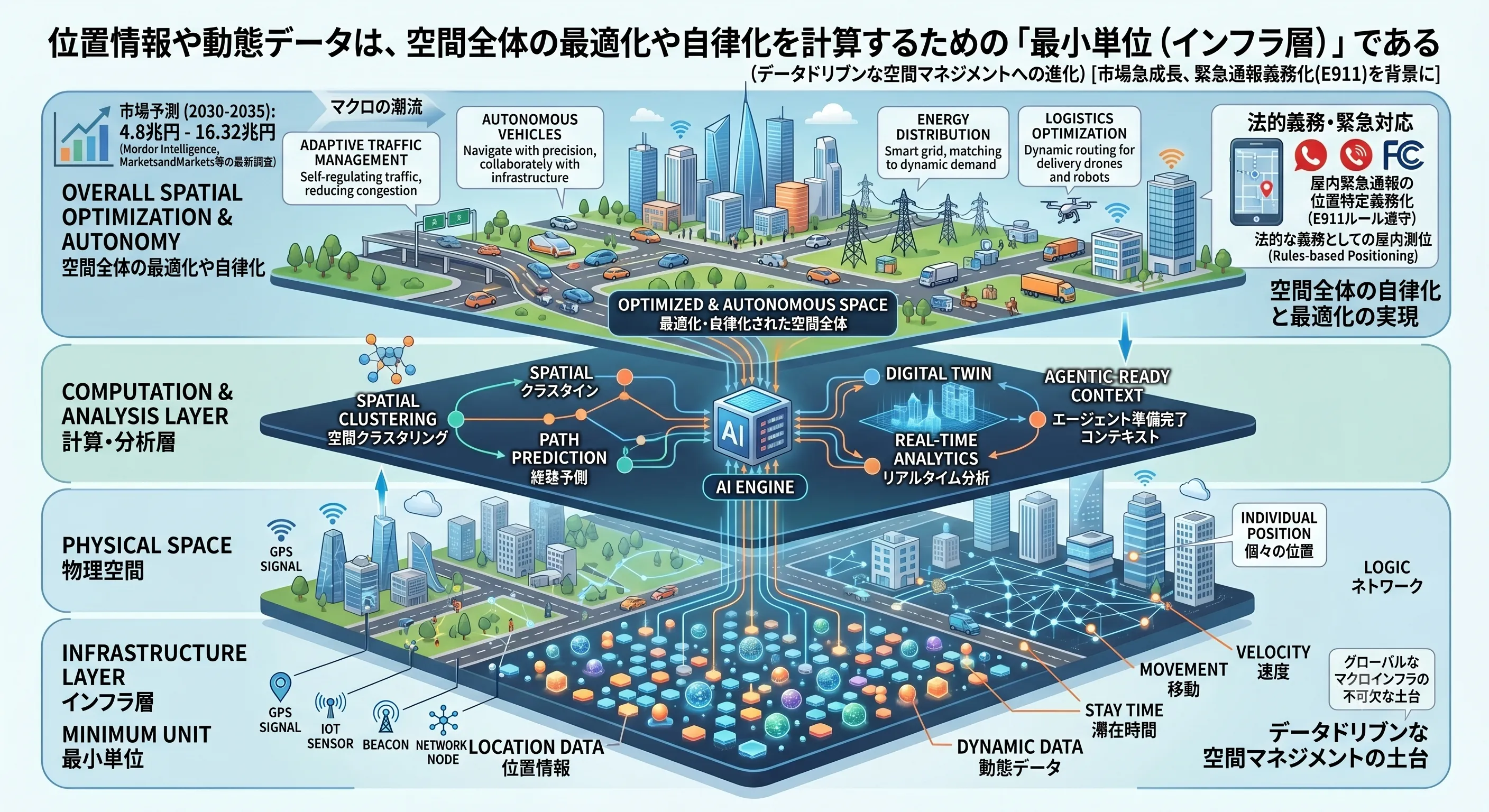
According to the latest research from Mordor Intelligence, MarketsandMarkets, and others,³ the global indoor-positioning market is projected to grow rapidly to a scale of roughly ¥4.8 trillion to ¥16.32 trillion by 2030–2035. Why is such an enormous market now rising so rapidly?
Behind it lies a global macro trend that goes beyond mere efficiency. With the rise of the “digital twin”—managing an entire facility in a 3D virtual space—real-time location data is no longer an option but an indispensable infrastructure at the lowest layer.
Furthermore, in the United States, the Federal Communications Commission (FCC) is advancing regulations (the E911 rules) that mandate high-accuracy location determination for emergency calls made from indoors. Indoor positioning is globally turning into a “legal obligation (a rule).”
Yet conventional technology in this huge market has been bottlenecked by the enormous cost of installing and maintaining hundreds of anchors (fixed stations) on the ceiling. We have succeeded in eliminating external equipment entirely using the power of edge AI alone, holding deployment costs to about one-tenth of the conventional approach.
When this infrastructure-less positioning is deployed on the floor, it dramatically visualizes and improves the customer’s operations—and at the same time, as a natural byproduct, it accumulates “living spatiotemporal data (a corpus) of the real world that no competitor can buy and no simulation can fabricate,” which is indispensable for training the model. This is the true nature of the data flywheel we set in motion.
👉 Why is the first “entry point” the factory or the warehouse?
In implementing physical AI in society, why did we set factories and logistics warehouses as our first targets? Because these spaces are, for an AI, “the highest-quality learning environment in the world, with the least noise.”
Consider, for example, that the biggest wall self-driving AI still faces today lies in the overwhelming “uncertainty” inherent to public roads. Pedestrians darting out unexpectedly, dizzyingly changing weather, vehicles ignoring traffic rules—it is overflowing with random noise that shakes the very premises of the AI’s learning.
A factory or warehouse, by contrast, is nothing other than a “highly controlled physical space.” It is clearly bounded by walls and ceilings, the floor is flat, and the lighting is constant. Above all, everyone who enters has received specialized safety training as a professional, and the attributes within the space are kept uniform. This “structure that has an appropriate degree of complexity yet never descends into chaos” is precisely what makes it the ideal environment for an AI—extremely low in noise and the most efficient place to accumulate high-quality data. Because the space itself is easy to reproduce as a digital twin (a virtual space), the AI can rapidly repeat countless trials and errors atop a system that mimics the real world.
More important still, factories and warehouses hold a decisive advantage for AI: the “goal of learning is exceedingly clear.” Severe performance indicators—output volume, utilization rate, defect rate, lead time, inventory turnover—are thrust forward day after day as clear “numbers.” This is exactly why an AI can learn, by the shortest route and without hesitation, what is correct and in which direction to move toward genuine improvement.
👉 Toward a “Self-Evolving Floor” Beyond Mere Labor Savings
What we are trying to realize is not the surface-level change of mere labor savings or automation. On the conventional floor, automated equipment simply moves as humans designed it, on the premise that “humans observe, humans judge, humans improve.” But on a floor where physical AI is introduced, the roles reverse. The floor itself learns from data and begins to seek out, on its own, improvements to “how to finish the work faster” and “how to eliminate the waste in this process,” pointing the way forward.
Picture, for instance, the AGVs (automated guided vehicles) running through a logistics warehouse. The spatial AI learns, day by day, the tacit knowledge that a veteran on the floor would hold—congestion in the aisles, unevenness in the workload, “when, at what timing, and where stagnation tends to occur.” Based on those results it autonomously fine-tunes the flow lines, raising overall efficiency from yesterday to today, and from today to tomorrow. The more you run the floor, the more data accumulates and the faster improvement compounds—a self-reproducing flywheel.
A state in which the entire space continues to evolve autonomously as a single, enormous physical AI. At that point, a logistics warehouse is no longer a mere collection of “robots that move packages”; the whole space transforms into “a machine possessing a single intelligence that completes the logistics.”
And the reach of this “space beginning to learn”—the range of physical AI—does not stop at factories and logistics warehouses. Every physical space where people gather, move, judge, and live out their lives becomes a canvas for our world model.
👉 The True Power of Spatial AI: Turning Every “Worn Device” into a Brain
And the reach of this “space beginning to learn” does not stop at factories and logistics warehouses. From here is the phase where zeteoh’s spatial AI demonstrates its true power.
The greatest strength of our technology is that it can be seamlessly implemented as software alone—with no additional hardware—on any moving object or wearable device that contains an “IMU (inertial) sensor,” from smartwatches and wireless earbuds to handheld terminals and forklifts.
There is no need to string expensive dedicated cameras and sensors throughout a city. The very smartwatch or earbuds a person wears every day transform into an “edge AI” that absorbs the noise of the physical world and converts it into the intelligence of the space. It is precisely because of this overwhelming portability and flexibility that our world model can break out of the “fortress” of the factory and expand without limit into every everyday space where people gather, move, judge, and live.
4. A Future Where Space Evolves Autonomously—“Liberating the Floor” Through Use Cases by Industry
The reach of the spatial AI we have honed in factories and logistics warehouses extends to every physical space where people gather, move, judge, and live.
Turn to retail stores, and they have been a black box where only the “result numbers” of sales and average spend per customer were visible. But with spatial AI, the “darkness of the purchasing process”—customer flow lines, dwell time in front of shelves, the hesitation between picking up a product and putting it back—is captured comprehensively as the behavioral data of the whole space, in a form that does not identify individuals. The store stops being a place managed by people and is elevated into a “machine that studies its own performance,” continually learning shelf allocation and flow-line optimization from how customers move.
In the office, it cuts into organizational stagnation that has been impossible to quantify until now—“too many meetings” and “slow decision-making.” By continually analyzing and learning seating arrangements, the movement of people, and the frequency of dialogue on a digital twin, the AI derives the optimal answer to “what conditions must align for an organization to move at maximum speed.” Every environmental element that makes up the office—lighting, room temperature, the distance between seats—transforms into a device that maximizes the performance of the people working there, based on learned data rather than human habit and rules of thumb.
And in the most pressing arena of all—healthcare and nursing care—it transforms the very definition of work from “reacting after the fact” to “preparing through prediction.” The biggest reason staff are driven to mental and physical exhaustion is a structure in which they can only move after an accident has occurred. Our “spatial-AI patented technology” learns the minute signs invisible to the human eye—a slight change in gait, a disturbance in flow lines, a bias in dwell time—and surfaces “a state in which something is about to happen” in advance. Staff can spend less time watching monitors and recover the time and emotional room to engage deeply with the people in their care. Near-misses are not left to end in individual willpower; they connect directly to structural improvements in the next day’s flow lines and equipment layout, autonomously raising the safety of the whole floor.
Where this future ultimately arrives is the smart home of 2030. In a super-aged society, going beyond the limits of concentrating the burden of care in facilities, physical AI supports the wish to “live at home, in a familiar place, until the very end.” A home that, without anyone being conscious of it, learns the daily changes in residents’ life rhythms and health, and autonomously adjusts the environment. The home itself becomes a new piece of social infrastructure—“the front line of preventive care,” equipped with the functions of prevention, watchful monitoring, and support.
5. Train the Model in Japan, Take It to the World
This philosophy of “infrastructure-less spatial AI” is not a pie in the sky. Our spatial AI has demonstrated state-of-the-art (SOTA) performance, surpassing well-known existing leading methods in inertial odometry (such as RoNIN and MambaIO) with lower trajectory error across every evaluation sequence in the academic benchmarks. Furthermore, we are advancing real-world social implementation in the present tense—including a technical validation with JR Central inside a moving Shinkansen, an extraordinarily harsh environment, and a paid project with a TSE-listed major audio-equipment and earbud maker toward integrating spatial AI into a next-generation B2B product.
This strategy is also clearly rational from a geopolitical standpoint. In Western markets, collecting “the movement data of people on the floor” at scale is structurally difficult, owing to strict privacy regulation (GDPR) and the cultural barrier of labor unions. Japan, by contrast, possesses a deep “monozukuri (craftsmanship) culture” and—through moves such as the bill to amend the Act on the Protection of Personal Information, approved by the Cabinet in April 2026 and now before the Diet, which proposes a new exception for the creation of statistical information (with AI development explicitly in view)—has made clear the government’s policy of aiming to be “the country where AI is easiest to develop in the world.”
Thoroughly train the world model using the ideal environment of Japan as a “data fortress,” and then export that trained brain to the world.
Physical AI is by no means a threat that steals human jobs. It is a system that turns every floor in the real world into “a place that keeps learning and keeps improving,” and that structurally puts in order the quality of human life and work—and our safety and breathing room.
Undistracted by the “fragments” of the robot frenzy, we will build the platform for the “infrastructure layer” that governs the physical world—starting from the floors of Japan.
References
[1] Global market analysis data from the international market-research firm Market Reports World (and major industrial-vehicle statistics).
JA: https://www.marketreportsworld.com/jp/market-reports/forklift-trucks-market-14718452
EN: https://www.marketreportsworld.com/market-reports/forklifts-lift-trucks-market-14717562
[2] The latest edition (5th edition) of the mobile-robot market report published by LogisticsIQ™, a global research firm specializing in logistics and supply chains. https://www.thelogisticsiq.com/research/automated-guided-vehicles-agv-market
[3] ・Mordor Intelligence 「Indoor Positioning And Navigation Market Size, Share & 2030 Growth Trends Report」https://www.mordorintelligence.com/industry-reports/indoor-positioning-and-navigation-market
・MarketsandMarkets「Indoor Location Market Report 2025-2029」 https://www.marketsandmarkets.com/Market-Reports/indoor-location-market-989.html